
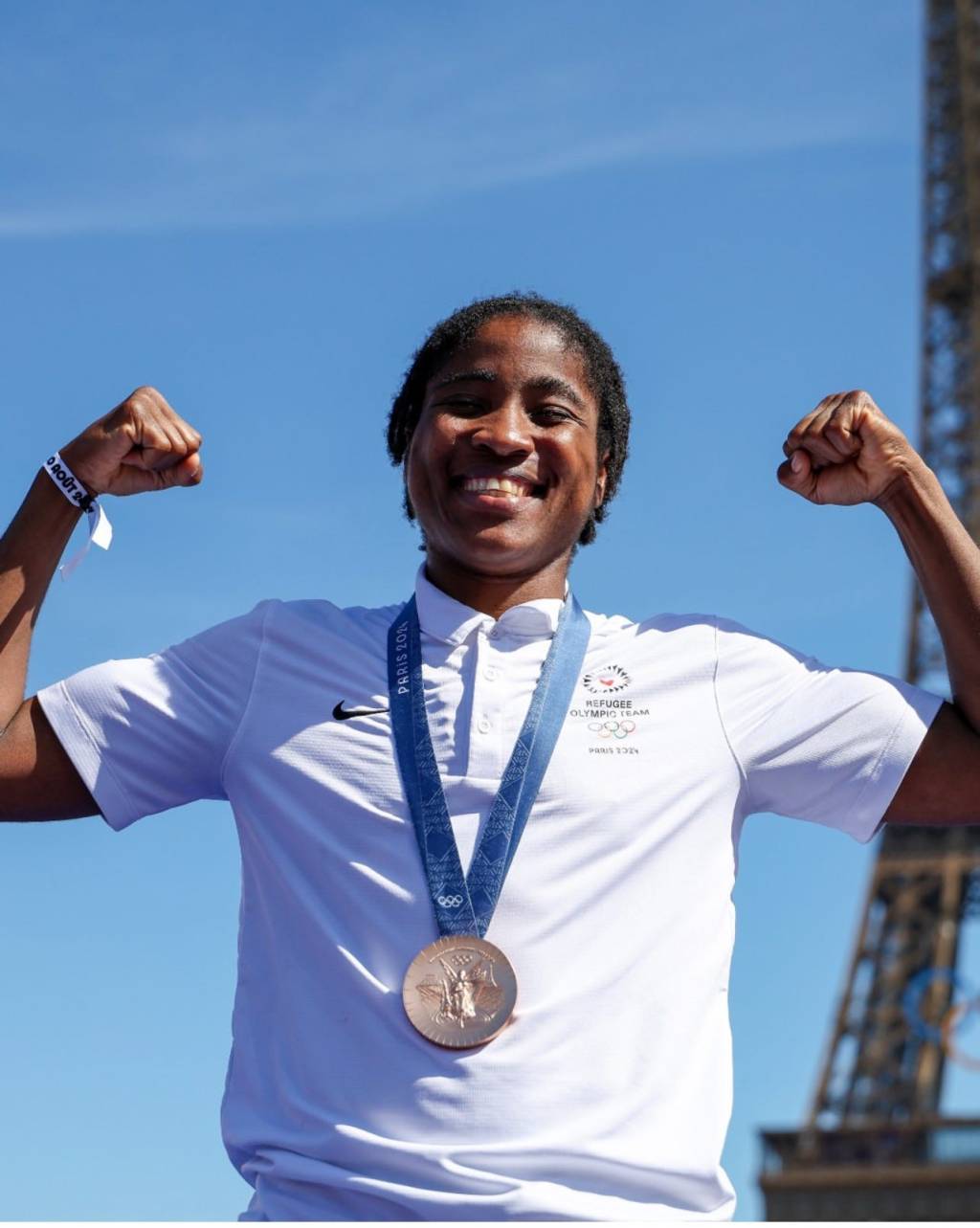
This week, Dernier Relais is pleased to offer you a slightly different article than the previous ones. The story is more unique than ever, and so is the athlete we met. However, this will not be a free-flowing conversation, but rather a story told by its main character.
Today, it is boxer Cindy Ngamba who is speaking to us, to you.
One year ago now, during the Paris 2024 Olympic Games, Cindy represented the Olympic Refugee Team. Never before her had a refugee athlete won a medal at the Olympics.
By winning bronze in the -75kg category, Cindy Ngamba entered the history of sport.
At our meeting, Cindy opened up at length, with a smile, talking about her childhood, her role models, her journey full of obstacles, her thirst for freedom, her coming out, the threats hanging over her, her faith, her matches.
Pour yourself a good coffee, sit back comfortably, let’s begin.
Childhood and discovering sport
“I believe that my relationship with sport — and with boxing even if I didn’t know it yet — goes back to my childhood in Cameroon, when I was 6, 7, 8 years old. My mother had 2 daughters and 4 sons, but my sister, much older than me, quickly left to live in France. I think that pushed my mother to even more want to see me as the little girl of the family, to dress me in dresses, pink shoes, etc. But me, that, I wasn’t interested at all.
No, what I wanted was to wear trousers, trainers. I was sporty, I hung out with the boys, I rolled tyres with a stick. I played hide and seek, football, cycling, and I would come home covered in scars. My mother wasn’t happy, that’s for sure, but like many others in Cameroon, I saw sport as a way to offer myself a great career, like Francis (Ngannou) in the UFC. The hope you have often lies in sport.
Then I arrived here in England, in Bolton to be exact, at the age of 11. I found a club that took care of young people. You could play sport there, there was a room with games, with an Xbox, and also — and maybe most importantly — people there to listen to you. It really was a place made so that young people didn’t hang out in the streets, to keep them busy and also to tell them that in life, there is a path to find and a career to build.
That club was a turning point. Before that, at home, I wasn’t doing anything, I would go out, come back a bit late after having fun, and when I found that club, I started playing football. You know, I had grown up in Cameroon with the image of Samuel Eto’o. He was the most famous to have come out of the country and succeeded in Europe. He was a role model for everyone. No matter which team he played for, in Cameroon, on match days, everyone stopped to watch him.
Very young, it stuck in my head that I too had to become a footballer. So when I had the opportunity here in England, I joined the women’s football team of my club. And what a disappointment! I didn’t like the training, I didn’t find it hard enough. But be careful, when I say that I’m not talking about the difficulty of the sport, but more about the intensity, which wasn’t enough for me.
That said, I also very quickly realised that team sports didn’t suit me. I found in individual sports a kind of pressure that ties you to yourself, your training, your involvement, your discipline, and the results you aim for and either achieve or not. It’s like life, in the end.”
Her encounter with boxing
“That’s where I come to boxing. I had never really paid attention to this sport until the 2012 Olympics in London. And there, there was this girl representing England, who was Black, like me. Her name was Nicola Adams, double Olympic gold medalist in… in… (she leans back and looks at the wall) 2012 and 2016! Sorry, I was looking for the info, her posters are on the wall! She laughs.
It was a revelation. I was watching her, this woman, Black, boxing with crazy energy and beating everyone. I was there, watching her, thinking ‘Wow! This girl is amazing!’ I could identify with someone!
Then one day, as I was finishing my football training, I saw a group of boys coming out of a room I didn’t know, not far from the pitch. Curious, I wondered where they were coming from. I went in, and that’s where I discovered the place, the boxing gym, filled exclusively with guys. They were hitting punching bags, jumping rope… Me, always looking for intensity, I thought ‘this is interesting!’ I had only one desire, to know more about this sport. So I went to see the coach, Dave Langhorn, who, although now retired, is still in my eyes my coach. I spoke to him, and he just replied: ‘Come back tomorrow.’
The next day, I thought I would arrive and start boxing! Instead, he handed me a skipping rope, and asked me to do sets of 10 alternating jump rope/push-ups, with this instruction: the faster I finished the set, the longer the rest time before the next one. On the other hand, the slower I was, the shorter the rest. That’s all I did for the entire hour and a half of my first session.
Then I came back, I kept going to the gym to do jump rope and push-ups. I gave it my all, I would often trip on the rope and fall. But I kept working again and again, and that’s all I did for two years! My coach is really old-school, you see. He made me understand that boxing is not just about putting on your gloves and getting in the ring. It’s a tough sport where you have to be serious. For him, hard work was essential. Whether you’re a girl or a boy, only the work mattered.
And the work paid off. When I started boxing, I weighed nearly 100 kg. After two years of jumping rope and push-ups, I was down to 90–91 kg. It had an effect on my mobility, I was more toned, faster, and the more I felt the changes in my body, the more I fell in love with boxing.
Then came the day he took me in front of a mirror and started teaching me how to move my head, how to move my feet, how to feint, how to position my hands. And that went on for a year. I was fighting my own reflection. Yes, one year of shadow boxing.
So of course, as time went by, I wanted to test myself, to see what I was worth. One day, as I arrived at the gym, Dave said to me: ‘Okay, put your gloves on, get in the ring.’ I was facing a boy. He was a giant! He must have been around 1.95 m tall, and I was about 1.73 m. But you know what, I didn’t care, I just wanted to box. Since I’m a girl, I could tell the boy didn’t dare to throw punches. The coach kept telling him, ‘Come on! Treat her like a boxer, hit her!’ So I thought, ‘Okay, if he’s allowed to throw punches, I’m not going to hold back either!’ So I boxed, and I hit him! I can tell you it really annoyed him.
You should know that during my three years of training, my coach kept repeating to me, ‘Be on your guard, if one day you get hit, it’s going to hurt!’ But once again, that never held me back. Anyway, this boy, I was hitting him, until he hit me back, and his hook sent me to the ground. And there, on the ground, I thought ‘Hey, that doesn’t hurt that much!’ I wanted to laugh! I got back up and said, ‘Come on, let’s go again!’
That day, my coach understood that I was crazy and passionate, and that I wanted to and was going to become stronger and more motivated.
That’s how I fell in love with this sport. Quickly, I tried to get into the Great Britain team, but since I didn’t have a British passport, it was impossible. I still don’t, by the way, I arrived as an immigrant, and I don’t have citizenship.
Boxing at a high level requires resources, so it was only possible by doing small jobs on the side, all while studying as well. I was boxing, studying, and working multiple jobs at the same time like waitress or cleaner. Not to mention the countless steps I took to try and regularise my situation with immigration services.”
Refugee status
“I obtained my refugee status in 2021, after 4 years of procedures, paperwork, and after being arrested and placed in a detention centre because I didn’t have the right to be on British soil… They released me because I had family here, who had citizenship. But it was hard, psychologically. I now mostly speak English, even though it wasn’t my mother tongue. I went to school here, I got a diploma here. And in Cameroon, I no longer have anyone, my relatives live in England, France, or the United States. It made no sense to be sent back to Cameroon. So when I arrived in that detention centre, I defended my situation with all I had in me to get out of there as quickly as possible.
It has always been a fight. I submitted my file to immigration services, and despite the systematic refusals, I kept believing in God, in boxing, and I submitted my application again and again. I couldn’t be sent back to Cameroon. I knew what was waiting for me there.
I understood very young that I was homosexual. I must have been 10, I think. I remember my best friend at the time was in love with my brother. She often asked me to tell my brother what she felt for him, but I never did, I wanted her to be in love with me.
Arriving here in the UK, I understood that everyone here is free to have their own sexuality and identity. You can see people on TV or on the internet speaking openly about their sexual orientation. So after a few years, I came out to my parents. My mother needed a year to recover! But I believe that when you have people from older African generations in your family, it’s kind of up to us to educate them on these things.
If I’m telling you this, it’s also so you understand why refugee status was so important to me. It’s illegal to be homosexual in Cameroon. You can be arrested, assaulted, harassed there. After the Olympics, many Cameroonians told me ‘how can you say things like that about your country?’, but it’s the truth. Homophobia is real and violent. And I will never hide who I am, a homosexual woman who needed protection.
I remember the day, at the immigration office, when they asked me to prove my homosexuality. I had to show the officer messages I had exchanged with my ex-girlfriend, it was crazy. But I guess they need to do their paperwork, have elements to put in the file, that’s how it is, I don’t complain.
Joining the Olympic Refugee Team, two years before the Paris 2024 Games, allowed me to benefit from additional resources that let me become a full-time athlete. Like athletes from major nations, I could finally focus on my career. From that moment on, I could take part in the biggest international competitions and represent the refugee team, face the best female boxers on the planet.”
Qualification for the Olympic Games
“I didn’t need to go through the qualifiers to go to the Olympics thanks to my refugee status. But I wanted to have the same merit as the others, the same journey. I’ve always fought to reach my goals, I had spent three years doing rope skipping, push-ups, and shadow boxing before even putting on gloves. And I never thought of giving up or doubting. Everything comes from work, and this goal of the Olympics would be no exception.
My first qualification tournament didn’t go as planned, I was quickly eliminated. But once again, I worked, and I earned my place during a second tournament. I wanted to prove to everyone and to myself that I had gone to get this Olympic spot, that I deserved it.
It was crazy, the media were all over me. I didn’t like that, I wanted to focus on my sport, but I educated myself in the way I talked to the media. I’m more comfortable now speaking up, talking about refugee athletes, fighting prejudices. I remember this refugee athlete a few years ago who was being interviewed. The journalist, condescendingly, asked if he was at least happy to be taking part in the Olympics. The athlete replied that we’re not here just to make up the numbers. That being a refugee doesn’t take away years of intense training, of struggle despite lack of means, that our ambition is intact, our dreams real. We want to win! No athlete gets into high-level competition and everything it involves just like that, by chance, without a huge desire to succeed behind it. I assure you, the prejudices about refugee athletes still make me angry.
On TV you only see a few minutes of smiles on the athletes’ faces, but people don’t always realise what’s behind that. I spoke to all the refugees at the Olympics, they come from all over the world, they all have their story, fled the worst things, and all trained hard, very hard, in sports to get to this level.”
Olympic Games, Women’s Boxing -75kg, Paris, 2024
“The Olympic tournament begins, and I learn that my first match will be against the Canadian (Tammara Thibeault). She was the favourite for the gold medal, she was much taller than me, boxing IQ super high, and I was so small next to her. I know Tammara well, she speaks French, she had already come to train in England, and at the Olympic village we used to chat quite a bit. So when we found out we were going to fight each other, we laughed, but the competitive instinct quickly took over, I wanted to knock her out of the tournament! Careful, it’s never personal. It’s boxing, sport, and a matter of technique. I know my technique. I know what I’ve learned. It’s a will to win that comes with an athlete’s mindset. You see, right now, we’re talking, I’m smiling, but in the ring, I have to adopt a different personality. Like when you have to give a presentation in front of an audience, you use a posture, a language, that fit the setting. You have to adapt, and life teaches you that. When I was young, I wanted to kill everyone, on and off the ring. I had to mature to become better.
That’s how I see things, I want to compartmentalise, activate mindsets and then deactivate them depending on what I’m doing and who I’m with. For example, I can’t mix boxing and family, I don’t talk about what happens in the ring with my family, and vice versa.
When they raised my hand after the match against Tammara, you can see it on my face, I was so happy, so stunned, and at the same time, I already knew I wanted more.
The next fight was against the French boxer (Davina Michel). Facing a Frenchwoman at the Paris Olympics! Honestly I thought, ‘OK… first the favourite, then the French fighter in front of her home crowd… God doesn’t want to make things easy for me!’ But once again, I had only one goal: to knock her out of the tournament. I knew I might be booed, I’m not stupid, if I were in the audience I would’ve done the same. But those boos at the start of the fight, I didn’t hear them, I didn’t hear any noise, I was so focused, so locked in on what I had to do, I only heard my coach’s voice in the corner.
Davina was more physically imposing than me. So just like with the Canadian, my strategy was to be more mobile, move my feet quickly, ‘in, out, in, out,’ be alert because she has a long reach and can quickly land hits that would put me in trouble.
When I won and secured a bronze medal, I was so proud. I remember pointing to the refugee flag and telling myself, ‘Did you see that? Do you see what a refugee can do? Are you impressed? Are you amazed?’ I was, and I thought of the little girl I used to be, and how far I had come.
I am proud to be the first Olympic medalist in the history of refugee athletes, and I hope this will give momentum to those who come after me, so different from one another and yet all united under the same flag. There are still so many barriers to break. So much progress to be made in how people see refugees, even beyond sport.”
And now?
“Today I’m trying to go professional. I also hope to soon get British citizenship, because refugee status doesn’t grant you all the rights, quite the opposite.
I should make my professional debut in November 2025, in London. I still have so much to prove. I want to show how far my boxing, my technique, and my speed can take me. And we’ll see what the future, and God, have in store for me.”

 Dernier Relais